
FRAVEye Expanding to Flower Production – Covering More Pests and Beneficial Species

Updated: Nov 7, 2025
Originally designed for whitefly and thrips monitoring in tomato and cucumber crops, FRAVEye is now expanding its applications into flower production and other protected cultivation systems. With new adaptations for humid environments, increased shading, and an extended list of monitored pest and beneficial species, FRAVEye continues to evolve into a versatile solution for greenhouse pest management and IPM support.
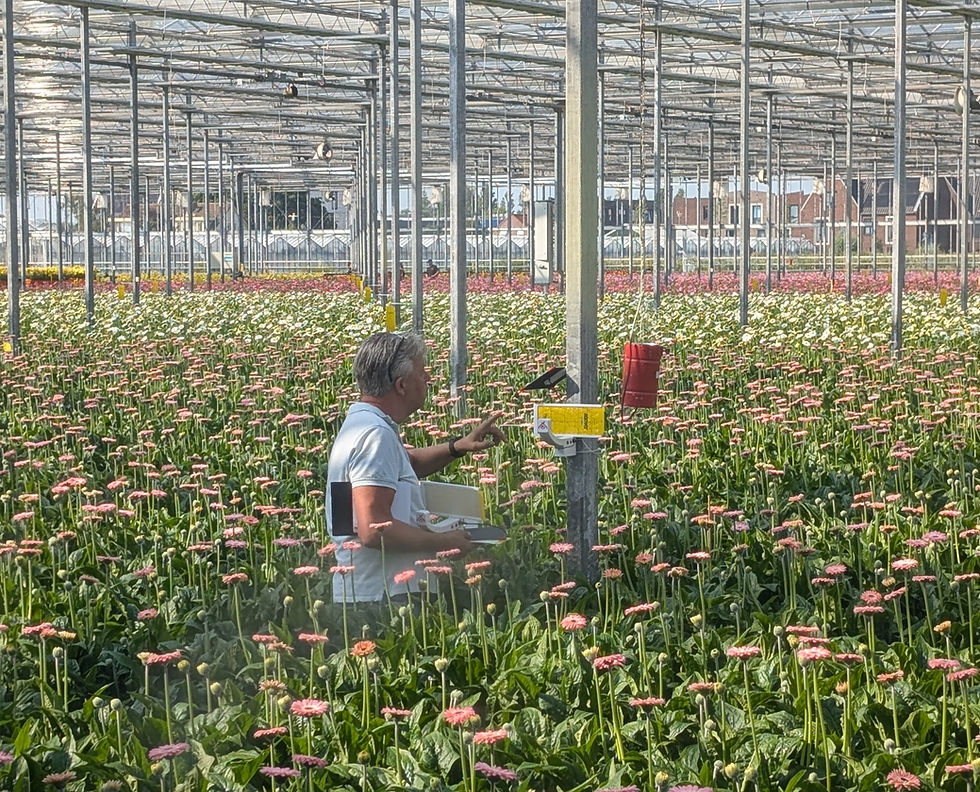
From High-Wire Crops to New Greenhouse Systems
FRAVEye was developed with a clear objective: to serve as a complementary device to the FRAVEBOT Scout, supporting pest population monitoring in high-wire crops.
Throughout its development, primarily focused on whitefly and thrips, we have received increasing interest from other sectors of greenhouse horticulture asking a simple question: Is FRAVEye applicable to tabletop cultivation or flower production?
Adapting to Humid Environments
The answer might seem straightforward, since many pest species are shared among greenhouse crops. However, several technical challenges arise from the original design of the FRAVEye. In many types of flower production, a high-humidity climate is desirable, and the device must withstand conditions similar to tropical environments, such as those in Phalaenopsis cultivation.

Managing Shading and Power Supply
Another key difference between vegetable and flower production greenhouses is the level of shading, particularly in crops where reduced light intensity is desirable, such as Phalaenopsis and other shade-loving ornamentals.
In these environments, shading screens are used extensively to create optimal growing conditions, which in turn reduces solar radiation available for charging solar-powered devices. To address this, we now offer an extension cable option, allowing the FRAVEye’s solar panel to be positioned above shading or blackout screens, ensuring sufficient energy intake.
Alternatively, the device can be connected directly to the power grid, a solution welcomed by many flower growers who already maintain a network of power sockets on greenhouse posts.

Expanding the Monitored Pest Range
At present, our monitored pest list includes whitefly, thrips, leafminers, aphids, fungus gnats, Tuta absoluta, and moths such as Chrysodeixis chalcites. With our expansion into protected cultivation systems such as polytunnels with strawberries, we are also conducting a pilot using red sticky cards for Drosophila suzukii, a major pest in soft fruit crops, especially raspberries. This pilot is currently in the data collection phase.

Including Beneficial Species in IPM Monitoring
Identification of beneficial predators is not always a priority for growers; however, in some IPM systems, monitoring both pest and beneficial species is essential. For example, leafminer vs. parasitoid (Diglyphus isaea) interactions provide valuable insights for biological control programs. We have therefore developed a dedicated model for this purpose. Another example is our Macrolophus pygmaeus model, which has already been successfully deployed. Currently, we are collecting data for Nesidiocoris tenuis, a related species commonly used as a biological control agent in cold tunnels, though it can cause crop damage under high-tech greenhouse conditions.
Fast Adaptation and Open Collaboration
What makes FRAVEye truly stand out is its adaptability. Every new pest, crop, or growing condition brings an opportunity to expand our models, and we can do it fast. Thanks to our efficient AI training pipeline, we’re able to move from data collection to functional model deployment within just a few weeks. This flexibility allows us to respond quickly to growers’ needs, wherever they are and whatever crops they grow.
We’re always open to collaboration, feedback, and new challenges, because that’s how FRAVEye keeps evolving together with the growers who inspire it.


Comments